Most commercial buildings don’t fail all at once. They slip a little more each quarter, until the rent roll softens, the maintenance calls stack up. A prospective tenant walks to a competitor’s newer space instead of yours. By the time the problem is obvious, you’ve already lost money you can’t get back.
The owners who protect asset value catch the signs that a commercial building needs renovation early. The fix is still a planned project instead of an emergency. This guide walks through the nine signals that matter most, physical, financial. Regulatory, with a New York City lens, because in NYC a “cosmetic” problem like a spalling facade is also a legal one.
If several of these rings are true, the building is telling you something. The question isn’t whether to act, but how to plan the work, which is where the full commercial building renovation planning in NYC guide picks up.
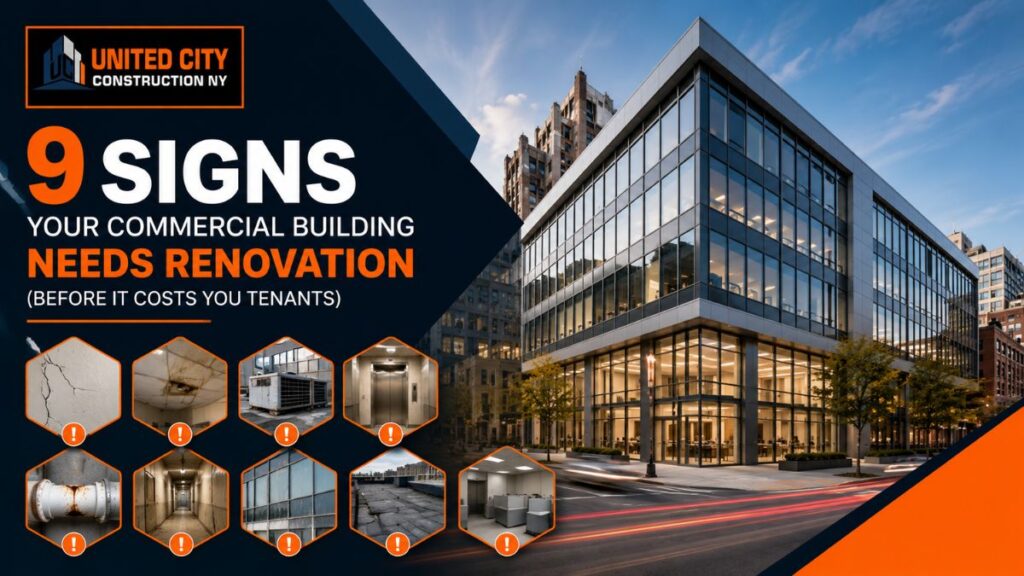
1. Visible Deterioration You Can’t Paint Over
Cracks in walls or ceilings, spalling concrete, water stains, mold, loose tiles, corroded railings. Cosmetic wear is one thing; these are structural and moisture warnings. In NYC, exterior deterioration carries a legal edge, under Local Law 11 (FISP), facade defects on buildings over six stories must be inspected and repaired on a fixed cycle. Unsafe conditions trigger mandatory sidewalk sheds that cost money every month they stand.
What it signals: deferred maintenance is compounding. The longer you wait, the more the repair scope grows.
2. Rising Utility Bills and Failing Systems
If the HVAC runs constantly and the energy bills still climb, the building envelope and mechanical systems are working against you. Older buildings leak conditioned air through single-pane windows, thin insulation, and worn-out equipment.
In NYC this is no longer just an expense, it’s a compliance risk. Local Law 97 caps carbon emissions for most buildings over 25,000 square feet, and inefficient systems push you toward penalties. A renovation that upgrades HVAC, lighting, and insulation cuts the bills and the fine exposure at once.
3. Constant, Escalating Repairs
One-off fixes are normal. A pattern isn’t. When you’re calling the plumber, the electrician, and the HVAC tech every month, the core systems are past their service life. At some point, repeated patch jobs cost more than a planned systems renovation, and you’re still left with old equipment.
Rule of thumb: when annual repair spend on a system approaches a meaningful share of what replacement would cost, replacement is the smarter money.
4. Outdated Layout That Fights How the Space Is Used
Space that worked in 2005 may fight today’s tenants, closed-off floor plans, too few meeting rooms, dead corners, poor flow. An inefficient layout quietly caps how much rent the square footage can command and how fast it leases.
What it signals: the building is functionally obsolete even if it’s structurally sound. Reconfiguring the floor plate often returns more than any finish upgrade.
5. You’re Losing Tenants, or Struggling to Fill Vacancies
Rising vacancy and shortening lease terms are the financial symptom of every physical problem above. Prospective tenants compare your space to newer inventory and negotiate down, or walk. If your building sits on the market longer than comparable properties nearby, the space itself is the objection.
6. Tired, Dated Aesthetics That Undercut Perceived Value
A worn lobby, dated lighting, scuffed floors, and 1990s finishes shape how every tenant, buyer, and broker perceives the asset, before they read a single number. First impressions set rent expectations. A tired common area tells a prospect the whole building is neglected, whether or not that’s true.
7. Accessibility and Code Gaps
ADA accessibility, current egress requirements, updated fire safety, older commercial buildings frequently fall short of today’s code. Beyond legal and liability exposure, these gaps shrink your tenant pool: many businesses can’t or won’t lease space that doesn’t meet accessibility standards. A renovation is the moment to close these gaps deliberately than under an inspector’s deadline.
8. The Building No Longer Matches Its Neighborhood
When the surrounding blocks upgrade, new construction, renovated storefronts, higher-end tenants, a dated building stands out for the wrong reasons. Repositioning to match a rising submarket can be one of the highest-return renovations an owner makes. The market rent has already moved; the building just hasn’t caught up.
9. A Sale, Refinance, or Repositioning Is on the Horizon
If you’re planning to sell, refinance, or reposition the asset in the next few years, a targeted renovation before that event can lift appraised value and net operating income more than the cost of the work. Timing matters: the improvements need to be in place and seasoned before the valuation.
How Many Signs Before You Act?
One sign is a maintenance item. Three or more clustered together, say, rising bills, escalating repairs, and softening occupancy, means the building has crossed from aging into needing a real renovation plan. The costliest path is waiting until a facade violation or a failed system forces your hand on someone else’s timeline.
The next move is turning these signals into a scoped, budgeted plan. Two pieces do that: the full step-by-step commercial renovation planning process. A clear-eyed look at what a commercial renovation actually costs and how to budget it, so the fix doesn’t become its own surprise.
Frequently Asked Questions
How often should a commercial building be renovated?
Most commercial buildings benefit from a cosmetic refresh every 5 to 7 years and a more substantial systems or layout renovation every 15 to 20 years. But calendar age matters less than condition, escalating repairs, rising energy bills, and tenant loss are better triggers than a fixed schedule.
Is it cheaper to renovate or replace an aging commercial building?
Renovation is almost always less expensive than demolition and new construction. In NYC it usually avoids the far longer permitting and zoning process a new build requires. Full replacement only makes sense when the structure itself is failing or the highest-and-best use of the land has changed dramatically.
Can facade problems force me to renovate in NYC?
Yes. Under Local Law 11 (the Facade Inspection Safety Program), buildings over six stories must have facades inspected on a recurring cycle. Unsafe conditions require repair plus a mandatory sidewalk shed until fixed. Those sheds cost money every month, so deferring facade work often costs more than doing it.
Will renovating actually increase my property value?
A well-targeted renovation typically raises both appraised value and net operating income by improving rents, cutting operating costs, and lowering vacancy. The return depends on scope and market, repositioning a dated building in a rising submarket usually delivers the strongest ROI.
What’s the first step once I’ve decided to renovate?
Start with a professional assessment: an existing-conditions survey and a code/compliance review to define what the building actually needs. That turns a list of symptoms into a scoped plan and an accurate budget, before you commit money to a specific design.
The Bottom Line
Your building sends signals long before a crisis. Deterioration, rising bills, escalating repairs, outdated layouts, and tenant loss aren’t separate problems, they’re the same problem at different stages. Catch them early, plan the renovation on your terms, and the building keeps earning. Wait, and NYC’s laws and market will eventually make the decision for you, at a worse price.